You face a familiar problem in wholesale sourcing discussions: three quotes arrive, the numbers look almost identical, and you still must choose reliable quartz slab manufacturer partners who will deliver the same slab quality on the first container and the last. Similar pricing tells you very little about what actually ships.
At wholesale volume, small defects become expensive fast. Shade variation across batches, warped slabs, failed inspections, and warranty disputes multiply with every pallet you accept. One weak batch can stall an entire installation schedule.
This guide gives you a systematic, evidence-based process for selecting a quartz slab supplier. You will learn to define requirements, verify quality, and score finalists on documented proof rather than sales claims.
Key Takeaways
-
Write a detailed specification sheet before you request quotes. This ensures every supplier bids on the same scope.
-
Inspect slabs in a fixed order: appearance, veins, surface, and flatness. This helps you spot defects quickly.
-
Ask for certifications and test reports from recognized labs. Complete documentation proves quality control.
-
Convert every quote to total installed cost per square foot. This reveals the true value of each offer.
-
Score finalists on a weighted scorecard using documented evidence. Let facts guide your final choice.
Define Wholesale Requirements and Normalize Quotes
Spec volume, thickness, finish, and edges
Build a written spec sheet before you request any quote. List order volume, slab dimensions, thickness, finish (polished or matte), edge profiles, and the delivery schedule. Standard thicknesses are 12mm, 20mm, and 30mm; 3cm is common for kitchens because it adds strength. Edge choice changes fabrication cost sharply — eased edges are typically included, while decorative profiles carry extra charges. A written spec forces every quartz slab and countertop manufacturer to quote the same scope.
Then ask three operational questions. What is your monthly capacity? What is your lead time and inventory status for this volume? How do you handle freight and breakage? The answers separate a quartz slab supplier who can serve a multi-phase project from one who cannot. Explore engineered quartz stone slabs to compare available slab specifications and finishes.
Compare true installed cost per square foot
Wholesale quartz slabs typically run $15–$60 per square foot before fabrication. That range hides real differences, so convert every quote to a total installed cost per square foot. Add fabrication labor, cutouts, edge work, freight, and expected waste. Professional installation labor alone runs $10–$30 per square foot, and each cutout typically adds $100–$200.
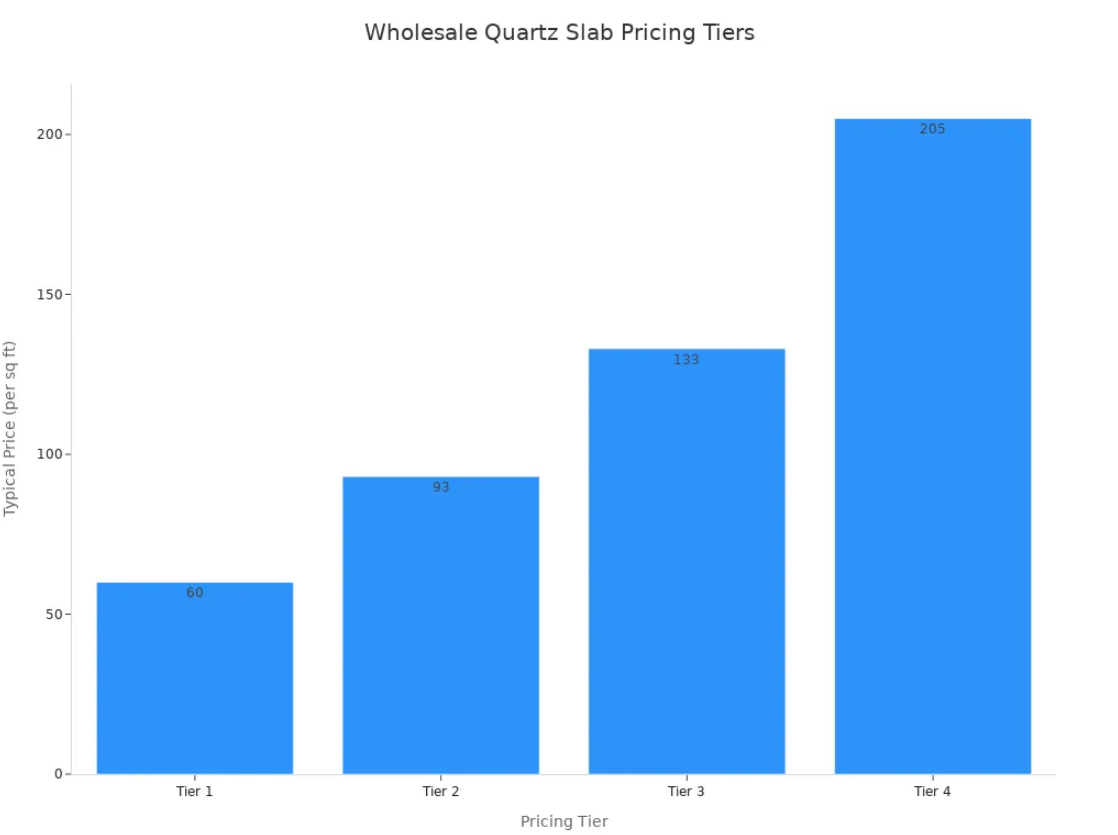

Pricing differences between brands like Caesarstone and Silestone are rarely more than a few dollars per square foot and vary by region and distributor relationship; negotiated fabricator pricing depends more on purchase volume than on brand choice.
Run one installed cost comparison across all bidders. Request samples, specifications, pricing, and lead times in the same format, and confirm warranty terms in writing. This keeps your quartz countertop manufacturer shortlist honest and comparable.
Assess Quality of High-Quality Quartz Slabs
Check appearance, veins, surface, and flatness
Inspect every slab in a fixed sequence. Start with overall appearance, then judge vein realism, then surface quality, then flatness. This order prevents a striking pattern from distracting you from structural faults.
View the slab under natural light and again with a flashlight at a low angle. Fine scratches show up more clearly on dark surfaces. Check edges and corners for chips, and look for pitting under angled lighting. Compare veining across the full face; improper material mixing produces discoloration and inconsistent movement.
Flatness decides whether fabrication runs smoothly. Run a straight edge along the length and width of the slab. Any gap signals warpage, which creates installation gaps later. Tap the surface gently with a hard object; a hollow sound points to internal fractures or voids. When a defect looks ambiguous, ask a fabricator or surface specialist for an expert opinion before you accept the lot.
Verify composition and batch consistency
Composition separates high-quality quartz slabs from budget material. Quality begins with raw materials: reliable quartz slab manufacturers use stable sources of quartz aggregates, resins, pigments, and additives. High-purity quartz powder appears clear, high-quality pigments hold their hue under UV exposure, and high-performance resin stays clean and bright without impurities.
Hardness gives you a quick field check. Quartz rates 7 on the Mohs scale. Scratch the surface with a sharp key; a high-quality quartz slab shows only a grey line that wipes away, while a low-quality slab takes a permanent scratch. Remember that finish and thickness also affect scratch resistance — polished surfaces and thicker slabs resist damage better than matte or thin ones.
Batch-to-batch consistency protects your schedule. Request samples from multiple production batches and confirm the supplier holds continuous batch availability. Compare background color, vein density, ink saturation, gloss level, thickness, flatness, and edge color across slab A, B, and C. Approve a batch range for large projects, reserve extra slabs from the same run, and label each slab by project area.
Documentation proves production consistency. Ask for batch numbers, mixing records, curing parameters, and final inspection reports. Reputable operations apply sampling plans such as ISO 2859-1 to incoming materials, which supports traceability and audit readiness.
Inventory depth is a practical signal. A supplier with local inventory and tagged slabs can pull matching material mid-project. Importers with deep stock suit phased schedules; direct factory partners suit custom runs. Either type works when the evidence supports stable quality and quality from batch to batch.

Verify Your Reliable Quartz Slab Supplier
Confirm certifications and test reports
Ask every candidate for a documentation packet before you negotiate price. Start with quality management certification. ISO 9001:2015 proves that the factory controls its management processes, meets customer requirements, and complies with regulations. That structure builds trust with buyers and supports a stronger brand. Then request product test reports from recognized labs such as NSF, SGS, and BV. These reports should cover hardness, stain resistance, and composition. You can also review MRD Stone's quality control procedures when assessing supplier documentation.
The table below shows the certifications you will encounter most often in the wholesale market and what each one covers.
| Certification | Purpose / Scope |
|---|---|
| GREENGUARD Gold | Indoor air quality |
| NSF/ANSI 51 | Food safety |
| ASTM International standards | Product standards compliance |
| Environmental Product Declarations (EPD) | Environmental impact (Zero/Low Silica collections) |
| ISO 14021 | Verified recycled content (Zero/Low Silica collections) |
A well-run quartz slab manufacturer keeps these documents ready for review. MRD STONE, for example, holds ISO9001, NSF, BV, and SGS certification and offers certificates and technical documentation to buyers on request. Treat complete certifications and documentation as a baseline, not a bonus. Missing paperwork signals weak quality control procedures.
Buyers in the wholesale market are advised to verify warranty details and quality control standards, ensuring every slab meets strict industry benchmarks for density, low porosity, and stain resistance.
Review warranty terms and accountability
Read the warranty before you sign, not after a claim. Most quartz countertop warranties run 15 to 25 years, or for life. Coverage typically excludes outdoor installation, improper use, damage from mishandling or excessive heat, thermal shock from hot cookware placed directly on the surface, and product not sold through an authorized retailer or installer. Confirm four points in writing: what is covered, for how long, who answers the claim, and how you resolve it across borders.
Brand terms vary in ways that matter to a project owner.
| Brand | Warranty Duration | Labor Coverage | Key Condition |
|---|---|---|---|
| Cambria | Lifetime (limited) | 1–5 years | Indoor residential use only |
| Caesarstone | Lifetime (limited) | 1–5 years | Must be registered within 30 days |
| Silestone | 25 years | 1–5 years | Must use authorized fabricator |
Strong warranty and accountability terms name a local contact and a resolution timeline. Verify export experience and project references next. A supplier with years of export history and verifiable references answers claims faster. Judge supplier reliability on this record, not on promises. Request multi-batch samples of quartz slabs, test reports, and a written warranty from each finalist quartz slab supplier before you award the contract.
Score and Choose Reliable Quartz Slab Manufacturer
Rate technical performance and project fit
Rate technical performance against documented process, not marketing language. Quartz is crushed, blended with resin, cured, calibrated to an exact thickness, and polished on industrial equipment. Those steps produce fewer chips, reliable scratch resistance, and a non-porous surface that resists wine, oils, and coffee without sealing. Tie every performance claim to the specific product's data sheet and test results. Check nominal thickness tolerance, usable slab dimensions, cutting yield, finish availability, and heat limitations in the care guide. Where key data is missing, treat suitability as unconfirmed.
Then match the product to the application. Confirm slab size against the project layout, thickness against the fabrication method, and the full pattern against directional veining. Calculate material yield before you commit. Countertop fabricators prioritize dimensions, thickness consistency, and cutting yield; distributors weigh repeat supply and packaging; developers plan for lifecycle procurement across future phases. A manufacturer scorecard keeps these judgments consistent across candidates. For product comparisons, see MRD Stone's artificial quartz stone slab collection.
Weigh compliance and true cost
Build one scorecard and run it on every finalist. Rate each candidate from 0 to 5, multiply by the weight, and keep supporting evidence beside each score. Treat missing critical evidence as a hold, not a gap that design appeal can fill.
| Criterion | Weight | What to verify |
|---|---|---|
| Specifications and quality evidence | 25% | Exact data sheet, tolerances, consistency, cutting guidance |
| Certifications and documentation | 20% | Current, product-specific, verifiable certificates |
| Warranty and accountability | 20% | Issuer, exclusions, claim process, replacement terms |
| Supply and schedule reliability | 20% | Inventory, lead time, lot availability, damage process |
| Installed value and local support | 15% | Comparable total quote, clear contractor responsibility |
Convert every quote to total installed cost before scoring. Labor and fabrication can range $10–$100 per square foot, and total installed cost spans $50–$200 per square foot. Waterfall edges, extra cutouts, and complex layouts add cost that a bare slab price hides. Shortlist two or three quartz slab suppliers, apply the same scorecard, and let documented evidence drive a reliable comparison. The lowest quote rarely delivers the best wholesale value; the strongest choice balances sourcing cost, quality, design, and repeat-business potential. Verify the warranty terms and replacement process in writing before you award the contract.
Your goal is best value backed by documented evidence, not the lowest quote or the flashiest sample. You now hold a repeatable sequence: define requirements, check quality, verify documentation, then score finalists. Before you award any wholesale contract, request multi-batch samples, current test reports, and a written warranty from each quartz slab supplier.
Shortlist two or three manufacturers and run the same scorecard on every one. Let verified evidence decide. That discipline is how you choose reliable quartz slab manufacturer partners who protect every slab and every warranty claim across a large wholesale project.
FAQ
How many sample batches should you request before ordering?
Request samples from at least three production batches. Compare background color, vein density, gloss, and thickness side by side. Approve a batch range in writing, then reserve extra slab material from the same run. This step protects your project from shade variation across a large order.
What lead time and capacity should a quartz slab manufacturer confirm?
Ask for monthly capacity, current inventory depth, and lead time for your exact volume. A supplier who serves quartz slabs wholesale projects should state these figures in writing. Confirm how they handle freight damage and breakage. Vague answers signal risk for phased schedules.
Which certifications matter most for quartz slab supplier verification?
Request ISO 9001 for quality management, plus product test reports from recognized labs such as NSF, SGS, and BV. These reports should cover hardness, stain resistance, and composition. Complete documentation is a baseline requirement, not a bonus. Missing paperwork points to weak quality control.
How do you resolve a warranty claim across borders?
Read the warranty before signing. Confirm what is covered, the duration, who answers claims, and the resolution timeline. Name a local contact in the agreement. Verify export experience and project references, because a supplier with a documented track record resolves claims faster than one without.